What’s Happening?
State of the Union
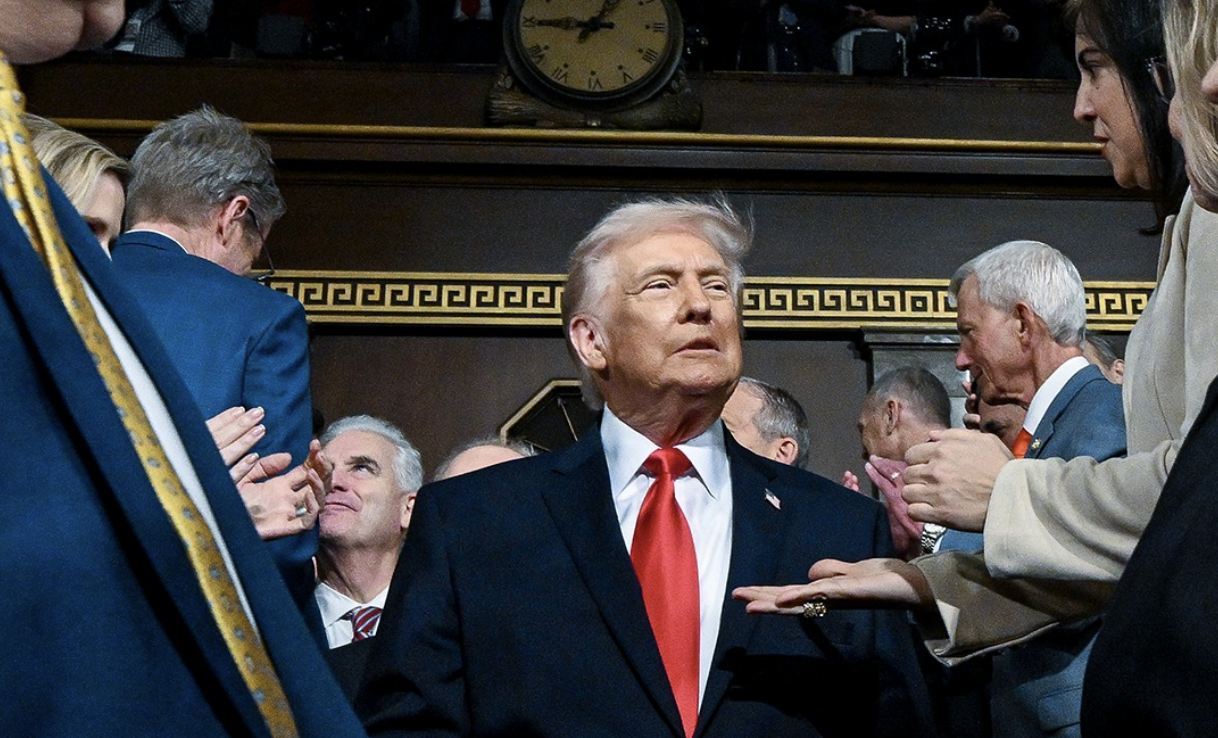
This week, Donald Trump delivered his first official State of the Union address to Congress, setting a new record as the longest presidential address to lawmakers in modern history. The speech was packed with policy signals that deserve a closer look.
Here’s what stood out:
- Continued attacks on immigrant communities: The President claimed that “importing these cultures through unrestricted immigration” brings problems to the U.S. This speech directly targeted Somali and Minnesota communities and paints diversity as a threat. It’s not. America’s diversity is our strength.
- Blame over the DHS funding standoff: The President blamed Democrats for a partial Department of Homeland Security shutdown. But while negotiations continue, agencies like ICE and CBP remain funded through his “One Big Beautiful Bill.” The real impact of the funding lapse? Agencies like FEMA and TSA, which handle disaster response and airport security.
- Direct appeal for the SAVE America Act: He doubled down on the false claim that “...cheating is rampant in our elections. It's rampant.” It’s not. Non-citizen voting is already illegal; this bill would actually make it harder for eligible Americans to vote. Full stop.
The takeaway: The State of the Union laid out a clear agenda: escalating attacks on immigrant communities, doubling down on enforcement over essential public services, and promoting false claims about election fraud to justify new voting restrictions. The throughline was division and control, not solutions to the real challenges families are facing.
Why the bill matters now
The most immediate test of that agenda is the SAVE America Act. As the Senate prepares to take it up, we must act now to stop new barriers to the ballot from becoming law.
Policy Perspectives
Trump and the GOP are increasing pressure to pass the SAVE America Act, calling it an “election integrity” bill. In reality, it would require Americans to produce citizenship documents, like a passport or birth certificate, to register to vote.
So what’s in the bill?
- Require proof of citizenship to register, but most IDs would not qualify
- Require strict photo ID to vote, and student IDs would be excluded
- Allow voter purges using error-prone databases
- Require states to share voter rolls with DHS
- Expose election officials to criminal penalties
- Provide no federal funding for implementation
Potential impact: An estimated 21 million Americans could be affected. Even scarier? The bill was amended in the House to add a directive requiring states to regularly submit their voter rolls to the Department of Homeland Security. If officials say you don’t have the right proof of citizenship, they can block you from voting — making the process more confusing and a lot more stressful..
Political context
The Administration is pushing the passage of the bill — and for good reason. They're scared about the 2026 midterm election results. Stagnant wages, constant uncertainty, increasing unemployment — President Trump is right to be worried, and he's doing everything he can to turn the election in his favour. And the SAVE Act will do just that.
On Our Radar
Updates on Burma Legislative Success
Last week, the House unanimously passed the BRAVE Burma Act (H.R. 3190), which would extend and expand sanctions on Burma’s military regime through 2032. The bill now moves to the Senate.
At the same time, a federal court has paused the administration’s attempt to end Temporary Protected Status for Burmese refugees. While the decision is under appeal, TPS holders remain protected for now.
Yet uncertainty continues. In February, Rohingya refugee Nurul Amin Shah Alam was found dead in Buffalo after reportedly being taken into custody. Questions remain about what happened and whether proper procedures were followed. Read more.
Trump’s Pressure to End Iran Nuclear Program
President Trump has ordered U.S. strikes on Iran, launching a military offensive on February 28, 2026 after negotiations over Iran’s nuclear program stalled and the administration cited threats tied to Iran’s missile and nuclear ambitions. The escalation has prompted Senator Tim Kaine and Rep. Ro Khanna to pledge votes on War Powers resolutions to end unauthorized hostilities and require Congress to approve any war with Iran.
What to know:
- Last month, Senator Tim Kaine (D-VA) and Senator Rand Paul (R-KY) introduced S.J. Res. 104, a resolution that would require the President to withdraw U.S. forces from conflict with Iran unless Congress formally approves military action or declares war. If passed, it would be legally binding.
- Representative Ro Khanna (D-CA-7) and Representative Thomas Massie (R-KY-4) introduced H. Con. Res. 38. This version sends the same message that Congress must approve war with Iran. However, because it is a concurrent resolution, it is not legally binding.
Rising Islamophobia
Anti-Muslim rhetoric is rising at both the federal and state levels. In early February, congressional hearings amplified anti-Muslim and anti-immigrant narratives pushed by dishonest witnesses, further normalizing harmful stereotypes. That climate has real consequences. In Michigan, Wyandotte Public Schools board member Cindy Kinney resigned after comparing Muslims to dogs on Facebook, prompting community outrage and formal condemnation from the board.
This bigotry is not isolated. In Florida, lawmakers are advancing controversial measures that civil liberties groups warn could unfairly target marginalized communities and expand state power, including proposals that raise serious due process concerns.
This bigotry is not isolated. In Florida, lawmakers are advancing controversial measures that civil liberties groups warn could unfairly target marginalized communities and expand state power, including proposals that raise serious due process concerns.
Hate and discrimination are rising — but so is resistance. We are calling out these attacks and holding leaders accountable. Emgage is celebrating 20 years of building Muslim civic power. To mark this anniversary, please consider a sustaining gift of $20/month for Emgage Action to ensure we can continue empowering Muslim communities in this crucial political moment.