
What’s Happening
A Win for Mail Voting, For Now
Last week, the Supreme Court of the United States (SCOTUS) left in place a lower-court decision blocking the U.S. Postal Service (USPS) from enforcing new restrictions on mail ballots for the 2026 midterm election. Overall, this was a win for voting rights (to Trump’s dismay). Organizations committed to protecting voting access, including Emgage Action, have been tracking the administration’s efforts to reshape how Americans vote. From the SAVE America Act to executive action targeting mail voting, organizations are staying vigilant to ensure we make access to the polls easier…not harder.
After the administration’s broader legislative efforts faced obstacles in Congress, President Trump issued an Executive Order directing the USPS to develop new rules governing election mail.
Why SCOTUS’ Decision Matters…for now
Lower courts already blocked the USPS from implementing key parts of Trump’s Executive Order and its resulting mail-voting rules. After USPS issued its final rule in August, a federal district court issued a new preliminary injunction blocking USPS from enforcing it for the midterm election. The administration then asked SCOTUS to lift that injunction.
SCOTUS said no. In a concise, unsigned order, the Court declined to pause the lower court’s injunction, leaving the restrictions blocked through the November 3rd election. The Court also stated that the government was unlikely to succeed on the merits of its challenge to the injunction.
Simply put this means that states can continue using their existing processes for mail voting this November. USPS cannot enforce the new requirements that would have allowed it to reject certain mail ballots or require states to upload voter information into a new federal mail-ballot portal.
What Would the Blocked Rule Have Changed?
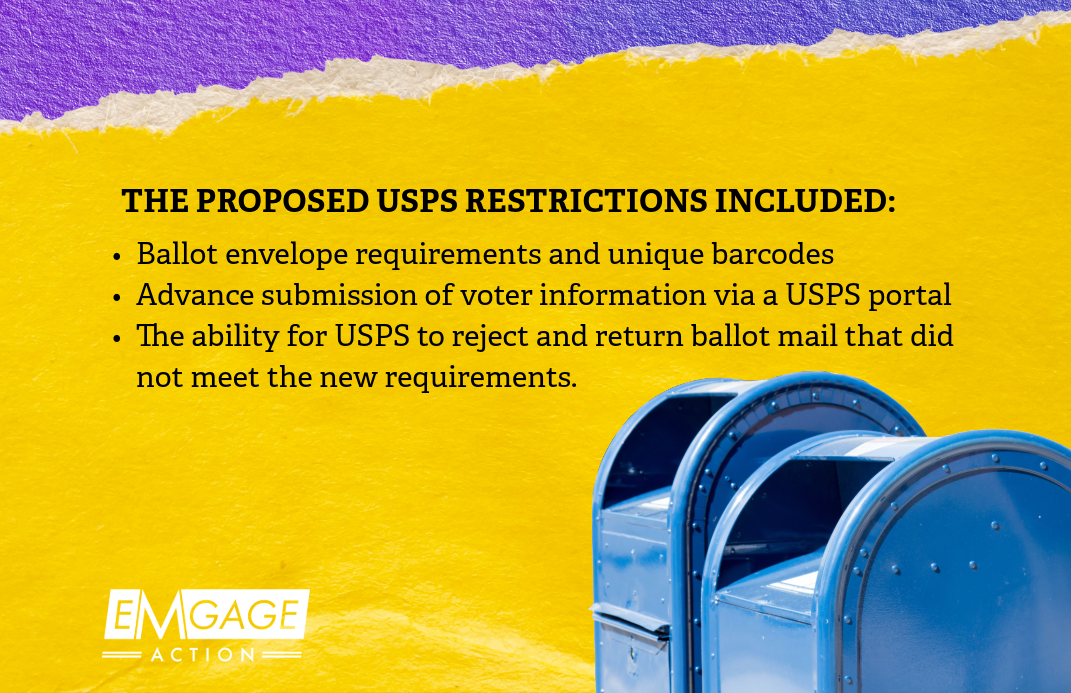
The USPS rule would have created new requirements for states and election officials, including:
- New ballot envelope requirements and unique barcodes;
- Advance submission of voter information to the new federal USPS portal; and
- The ability for USPS to reject and return ballot mail that did not meet the new requirements.
Election officials and voting organizations challenged the rule, arguing that implementing these changes just weeks before midterm elections would create significant administrative burdens and risk voters not receiving their ballots.
For now, those changes will not apply to the 2026 election.
But this is not the end of the legal fight. SCOTUS’ September 14th decision addressed whether the lower court’s injunction should be paused while the case proceeds; it did not issue a final ruling resolving the underlying legal questions surrounding the USPS rule or the Executive Order.
Our Perspective
The Ballot is More Than a Piece of Paper
Voting rights don’t mean much if voters can’t realistically access the ballot.
That’s where organizing comes in.
At Emgage Action, we work year-round to make sure Muslim Americans understand their rights, know what’s changing, and have the information they need to participate. Protecting the ballot means more than defending what happens inside the voting booth. It means pushing back when new rules create unnecessary barriers and making sure our communities know how those rules affect them.
One important piece of that fight is voting by mail.
You may hear the terms mail-in voting and absentee voting used interchangeably, but the exact rules depend on the state. Generally, both refer to eligible voters casting a ballot without voting in person at a polling place on Election Day. Some states require a specific reason to vote absentee, while others allow voters to request a mail ballot without providing an excuse.
For voters who are working long hours, caring for family, living far from their polling place, serving overseas, or facing accessibility barriers, mail voting can be the difference between being able to participate and being shut out.
That’s why this Supreme Court decision matters.
The new USPS requirements are blocked for the 2026 election, and states can continue using their existing mail-voting processes. But we aren’t taking anything for granted.
Protecting our vote requires more than watching what happens in Washington. It requires organizing at home, educating our communities, tracking changes, knowing the rules, and making sure eligible voters have a path to the ballot.
The fight over voting access is happening all year. So is our organizing.
ON OUR RADAR
Diplomacy, With a Threat
On Tuesday, September 22nd, Trump used his U.N. address to defend the ongoing war with Iran and issue a stark warning of further escalation. He said Iran faces a choice between reaching a deal or facing what he called the “annihilation” of the Islamic Republic. Trump also insisted that the upcoming midterms would not influence his Iran policy, while pointing to the prevention of a nuclear-armed Iran as his central concern. His remarks came as world leaders gathered for the U.N.’s annual General Debate, focused on global cooperation and peace.
The Vote That Will Have to Wait
A surprise early recess means the House won’t take up Rep. Thomas Massie’s impeachment resolution against Defense Secretary Pete Hegseth until after the November elections. Massie argues Hegseth exceeded his authority in directing military operations, particularly in Iran, while Johnson has rejected the allegations and defended the defense secretary. The timing has drawn attention because the resolution would otherwise have required the House to act within two legislative days. Lawmakers are now scheduled to return November 9.
Banned From the Briefing Room
Reporters from CNN, MS NOW and Politico were turned away from the White House after President Trump announced a ban on the outlets, citing what he called unfair coverage. The three organizations have sued the administration, arguing that the restrictions violate their First Amendment rights and deny journalists due process. Major television networks also suspended the traditional White House video pool rather than replace CNN. The dispute puts press access, and the government’s ability to restrict journalists based on their coverage, at the center of a new legal battle.
760,000 Affordable Care Act Enrollees on the Chopping Block
The Trump administration says it plans to remove 760,000 people from Affordable Care Act exchanges, alleging they were fraudulently enrolled or do not actually exist. Vice President JD Vance said the move would cancel roughly $2.2 billion in subsidy payments, as part of a broader administration effort to combat fraud in federal health programs. The administration is also suspending new brokers accused of disproportionately contributing to fraudulent enrollments. The announcement comes as ACA premiums and healthcare costs remain a major concern heading into the midterm elections.